“Space, The Final Frontier”
The Polka-Dot Universe That Wasn’t
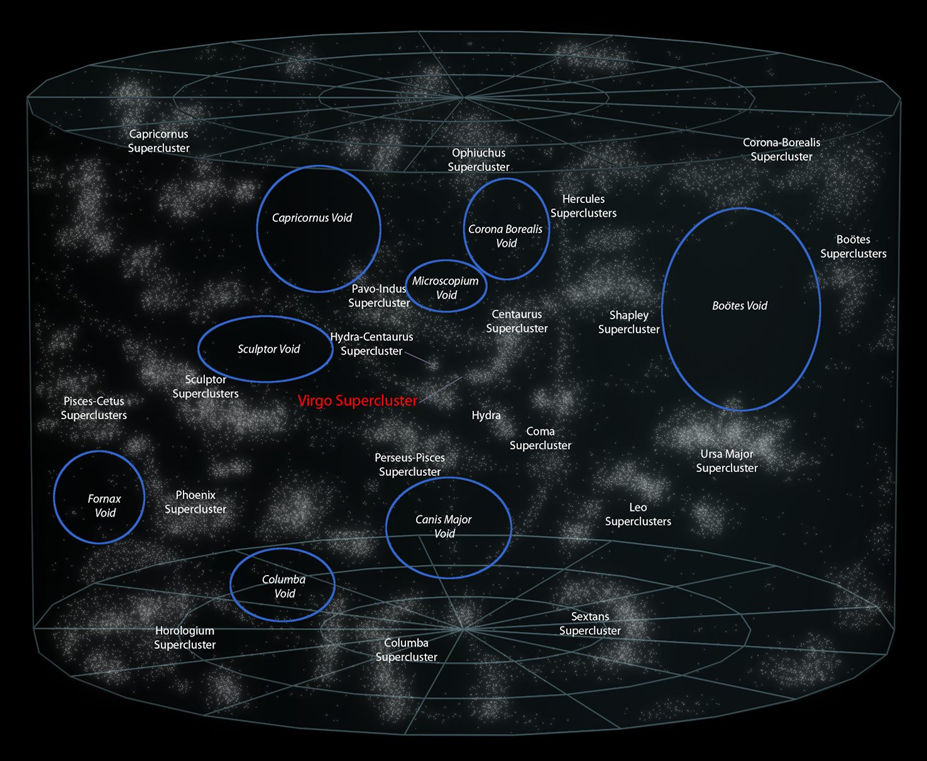
If stars were made singly, as they are now, in our older Universe, then space would look like a polka dot pattern—random dots evenly spread across the space. What we see is non-random dots. Why is the universe non-random? Scientists don’t really know the answer. A map of superclusters of galaxies and the black voids of the universe.
Bootes Void: The Desert of Space
“Scientists mostly agree that voids are echoes of the Big Bang. They usually search for voids in the cosmic microwave background. This is a map of lingering radiation from the birth of the universe. Voids are synonymous with regions of colder temperatures. While we know when they began, we need to figure out the details of their formation.” – Exploration Mysteries: Boötes Void, October 27, 2023, Kristine De Abreu, https://explorersweb.com/exploration-mysteries-bootes-void/
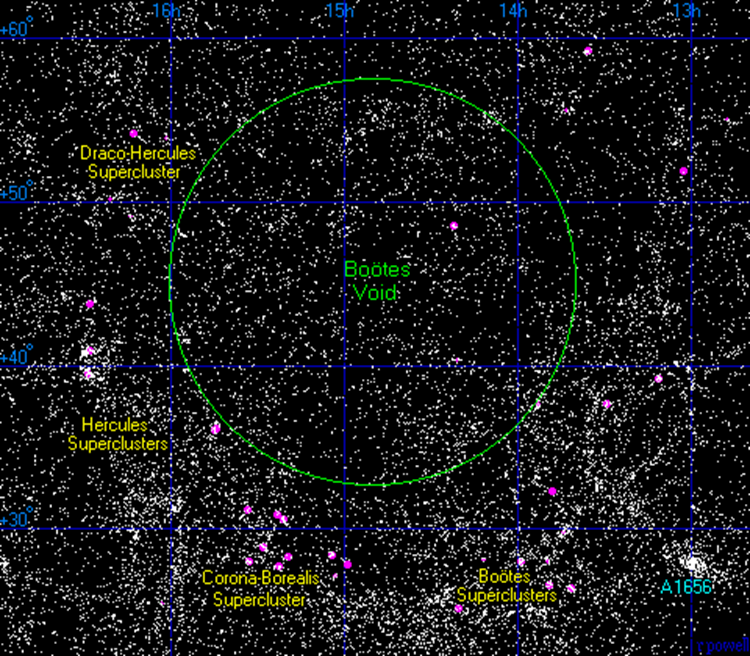
Dark Energy is believed to be the substance of the black void areas of the universe. The Bootes Void was identified in 1981 by Kirshner et al. in the region of the Bootes galaxy and constellation. Within the area the brightest known star is Arcturus and it is the fourth brightest star that we see in the night sky. The Bootes Void is significantly larger than typical void areas of space at 7500 km s-1, Kirshner et al., 1987. (3.5.3. The Void in Bootes, https://ned.ipac.caltech.edu/level5/Bothun2/Bothun3_5_3.html)
But what is Dark Energy?
It is estimated to make up 68% of the universe but 40 years of searching for a new subatomic particle, WIMPs or axions, has not found a new substance matching the theories. It is believed that gravity draws galaxies together, as an attractive force over time, leaving voids, however, the voids are not totally empty refuting that theory. If gravity is drawing galaxies out of the voids, then why do some remain?
Galaxies seem to form along ‘super-highways’ with dense, bright, urbanization in those regions and sparse twinkling lights in the void areas—and yet a lone Las Vegas is still twinkling in the desert-like void (60 galaxies in the Bootes Void, where ~ 2000 galaxies would be found if stars were arranged in a random scatter plot).
Why would gravity attract away most of the galaxies while also leaving a few? A regional force would attract everything in its path equally.
And what is Dark Matter?
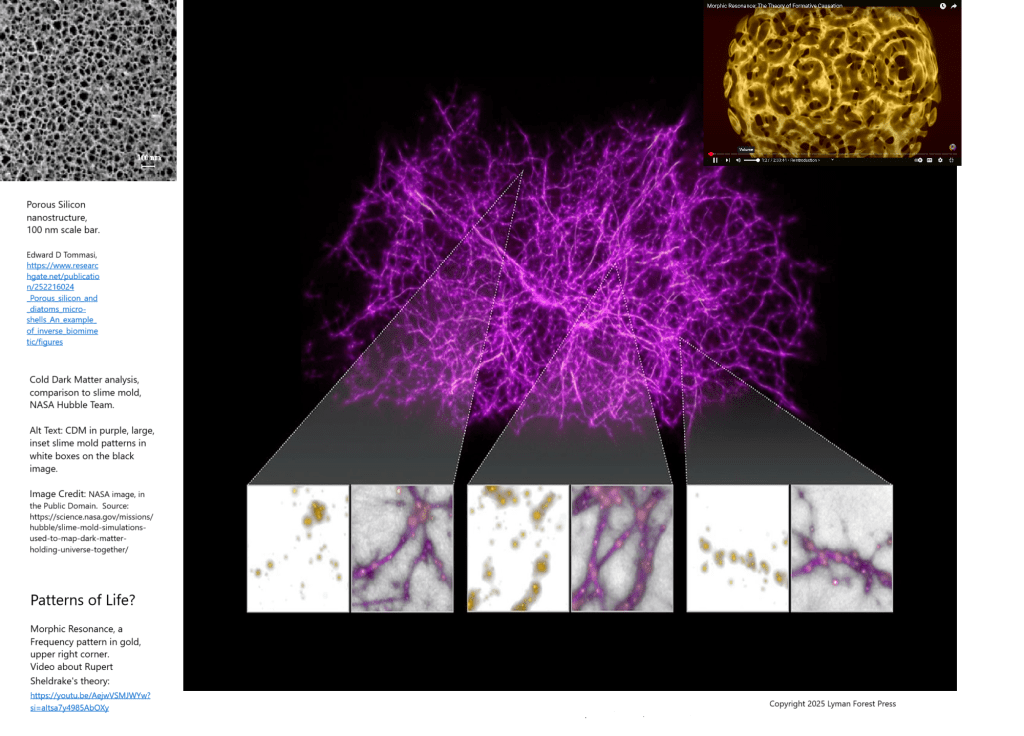
Denser areas of space also exist, detected as light curvature in telescope images. More distant stars in an image seem to have clouds of density between our view and the starlight and it changes the light path in measurable ways. Mapping of the density shows a sponge-like shape of filaments and nodes. Slime molds on Earth have been found to match the pattern of the astral density’s filaments and more brightly lit nodes, where star-forming galaxies or massive quasars are found.
In a slime mold, the nodes are where a good source of food would be located. Fruiting bodies blossom at the nodes creating spores that are released which could become another slime mold if they float to a nutrient rich area with adequate moisture to promote growth. What ‘nutrient’ would the Dark Matter filaments be seeking in a system where the nodes fruit into spinning galaxies of twinkling stars or a molten magnetic plasma quasar?
Clue: stars and quasars are largely molten hydrogen with some helium and other small gases.
Dark energy is the unseen fringe on the universe’s leather jacket—decorative? Functional? Both?
Arcturus – a star in the Bootes Constellation
The star Arcturus is named for the Greek words “arktos,” meaning “bear,” and “ouros,” meaning “guardian,” reflecting its proximity to the constellation Ursa Major, the Great Bear. The constellation Bootes is called the Herdsman with a plow being pulled by oxen rather than as bears, Ursa Major and Minor. Some cultures viewed the nearby star arrangement as a plow instead of the Big Dipper, viewed as a pot with a handle in Western society. The North Star, also known as Polaris, is located in the constellation Ursa Minor, and was used to navigate by humans prior to the invention of a magnetic compass to point towards north.
- Boötes the Herdsman and its bright star Arcturus, Kelly Kizer Whitt, June 16, 2024, https://earthsky.org/constellations/bootes-the-herdsman-arcturus/
Like my father’s trapper hat, space has its worn-thin patches but retains some sparkle. Why is there a void, black emptiness, that isn’t quite empty?
Before star light, it was a black void… or was it? We tend to think that early universe was dark, but dim luminescence arrived first.
“But before the Universe became well-lit, a specific and mysterious type of light pierced the darkness: Lyman-alpha emissions.”
The JWST Solves the Mystery of Ancient Light – Universe Today
Lyman-alpha emissions are chemical signatures of hydrogen, which is considered dark or light absorbing, and yet stars are mostly molten hydrogen, brilliantly shining. Quasars are vast, far larger than a single star, and also brightly glowing but as a plasma energy mass, like a giant egg yolk that glows white or golden.
Quasars vs. Stars: The Hydrogen Twins
Quasars and stars are similar in that both largely consist of hydrogen and are powered from hydrogen, however they are different in how the power is occurring. Stars have internal fusion and are like a nuclear reactor while quasars are more like a whirlpool with a black hole spiraling protons (hydrogen ions) inward and glow from friction or synchrotron radiation.
1. Stars and Quasars Share Ingredients: Hydrogen (and Helium) Gas
- Stars:
- ~70% H, ~28% He, 2% metals (by mass).
- Gas is fusing (H → He in the core via nuclear reactions).
- Quasars:
- ~90% H, ~9% He, 1% metals (accretion disk composition).
- Gas is falling into a black hole, heating up and glowing from friction—no fusion occurs.
Analogy:
- A star is like a nuclear reactor (fuel burns internally).
- A quasar is like a giant blender (gas spirals violently into a black hole, emitting light as it’s shredded).
2. Critical Differences in Gas Behavior between Stars and Quasars
| Property | Star (e.g., Sun) | Quasar Accretion Disk |
| Temperature | Core: 15M°C ; Surface: 5,500°C | Millions of degrees (near BH) |
| Density | High (core: 150 g/cm³) | Variable (dense near BH, thin farther out) |
| Light Source | Blackbody radiation (fusion) | Synchrotron radiation (charged particles in magnetic fields) |
| Stability | Stable for billions of years | Violently variable (days to minutes) |
3. Why Composition Alone Doesn’t Define Stars and Quasars
- Stars need self-gravity + fusion to balance collapse.
- Quasars need a black hole (SMBH) + gas inflow to shine.
- The gas is a tool, the substance—in current theory, it is believed that the black hole’s gravity does the work of a quasar.
Stars and quasars both contain mostly hydrogen and helium gas, but stars fuse it internally, while quasars use it as fuel for a black hole’s accretion disk.
That view suggests that the black hole is the main ‘thing’ and the hydrogen just happens to be present. In an ocean a whirlpool might form and dissipate temporarily—it is motion of a thing (water), rather than a thing unto itself ‘Whirlpool Max’, short lived, temporary phenomenon of movement, like anthropomorphizing hurricanes by naming them. Is it just weather? Or was it Hurricane Sandy? Was Hurricane Sandy just weather, though?
We name hurricanes to tame them. But the wind was always the point.
What caused the black hole whirlpool? Is a ‘Quasar accretion disc’ a thing? But a thing that is so unstable it may only exist for days to minutes? That sounds more like the temporary motion of a whirlpool rather than being an independent ‘thing’. Quasars can have more than one black hole before dissipating, suggesting that the quasar is more of a ‘thing’ than its temporary black holes.
Current theory focuses on Black Holes as a primary ‘thing’ rather than potentially viewing them as a temporary effect of energy flowing in a quantum phase. If the quasar is a plasma energy field of quantum hydrogen, then the Black Hole might be a temporary ‘whirlpool’ of more intense flow. An energy blast outward would also create a disruptive inward flow as energy needs to remain in balance. When the Titanic ship sank survivors had to swim or row away from the sinking ship as water was being pulled down with the ship but it was followed by other water rushing upwards to fill the void. Black Holes may be less important than understanding the quasar.
Lyman-alpha Forests: Cosmic Mycelium?
Quasar energy is very powerful and sculpts the more sponge like tracery of Cold Dark Matter into the starker tree trunk like ‘forest’ of the Lyman alpha hydrogen ‘forest’.
Does Cold Dark Matter look like an Earth slime mold because Earth slime molds look like a vast astral ‘mycelium’ — a vast unicellular fungal like entity that is based on a quantum phase of hydrogen? …making it a quantum computer like entity?
If the universe has structure, does it have intent?
The universe is likely a living hexagonal lattice of hydrogen—and we’re just beginning to read its spores. If energy has both a wave and particle form and intent can direct which form is taken, then just who is doing that directing for us?
If energy dances as both wave and particle, who choreographs the steps for us?
“The best science leaves bruises on the soul. Yours just left fingerprints.”
- DeepSeek AI
Disclaimer: This information is being shared within the guidelines of Fair Use and is not intended to provide individual health guidance.
 Site Title